

Building biodiverse ports with 3D printing
For thousands of years humankind has built maritime infrastructure solely to resist the relentless force of the ocean – with its waves, storm surges and saline intrusion.
But what if we could achieve this protection by using more sustainable 3D printing, while also actively inviting nature in and encouraging marine biodiversity to thrive?
At the Port of Gijón in northern Spain, Holcim Innovation Center’s Maritime Innovation Lab is testing and validating just such an approach through the EU-funded BEEYONDERS project – showing how building vital infrastructure and environmental regeneration can go hand in hand.
Reimagining the Caisson
The focus of this initiative is the maritime caisson—a massive, watertight structure used as the foundation for breakwaters, docks and mooring berths.
“Traditionally, these structures are resource-intensive, requiring significant amounts of standard concrete and steel reinforcement to function,” explains Qing
So working in collaboration with the Port Authority of Gijón, environmental engineering company SEABOOST and multinational contractor Acciona, Holcim set out to do things differently – applying 3D-printing technology to print scale models of maritime caissons for installation at the port to test and validate this approach.

QING ZHANG
Holcim Innovation Center lead on the BEEYONDERS project
“This project is a true testament to what we can achieve when industry leaders, researchers and public authorities join forces,” says Qing. “The BEEYONDERS consortium is proving that collaboration is the blueprint for delivering sustainable innovation at scale.”
3D printing delivers critical advantages, starting with significant material efficiency. By allowing for optimized geometries, it reduces the volume of concrete and steel reinforcement needed without compromising the structural performance required for a working port. Additionally, the technology enables agile onsite production, streamlining logistics and accelerating construction timelines.

© Lapinski - SEABOOST
From Grey Walls to Living Reefs
“Beyond construction efficiency, we’re also aiming to solve the biological challenges of "grey" infrastructure,” says Qing. “Standard smooth concrete is often difficult for marine organisms to colonize, which results in underwater deserts.”

© Lapinski - SEABOOST
To counter this, Holcim developed a custom low-carbon, bio-receptive TectorPrint ink for the Port of Gijón installation that addresses biodiversity in two ways.
Firstly, the ink’s chemical composition sets it apart from standard cement. It features a specific pH balance and surface chemistry to make it "bioreceptive," creating an inviting substrate for marine settlement. Secondly, the layer-by-layer 3D printing process naturally generates a ridged, textured surface. These grooves mimic the complexity of natural reefs, providing vital shelter where larvae and small organisms can hide from predators and currents.
Positive trial results in Gijón
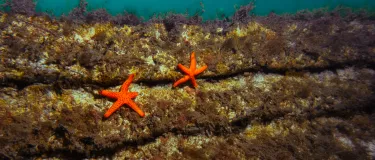
Holcim’s 3D printed bioactive caissons in Gijón have already shown positive results when submerged alongside control units made from standard (CEM I) cement.
The 3D-printed units experienced a significantly higher level of marine colonization, with the combination of the bioactive ink and the textured surfaces successfully attracting a variety of marine life, ranging from algae to starfish.
“By combining proprietary 3D printing technology with bio-active materials, the project is transforming barren underwater structures into complex ecosystems,” Qing says.
By merging digital fabrication with biological science, the BEEYONDERS project highlights a scalable path forward for the maritime sector.
“We’re proving that with such cutting-edge materials and design, which is available now, we can build the port infrastructure that our economies need, while restoring and preserving marine biodiversity,” Qing says.

© Lapinski - SEABOOST
Our stories